The WCAG 2.1 contrast ratio for any two hex colours, with a separate verdict at every threshold that matters: AA and AAA for normal body text at 4.5 and 7, AA and AAA for large text at 3 and 4.5, and 3 for UI components and graphical objects such as icons, borders and focus rings. Each colour's relative luminance is shown alongside, computed with the piecewise sRGB linearisation the standard actually specifies rather than a gamma approximation. White on black reads exactly 21:1, and the page shows you the sample text rendered in the pair you picked.
Six-digit and three-digit hex both work, with or without the leading hash. Each channel is linearised with the WCAG 2.1 piecewise curve before the weighted sum, and the ratio is (L1 + 0.05) / (L2 + 0.05) with the lighter colour on top — so white on black is exactly 21, not 20.9-something.

Layer up to three shadows with x, y, blur, spread, opacity and inset, then copy the CSS.

Drag the two control points on a curve, watch the easing play and copy the cubic-bezier CSS.

Convert HEX, RGB, HSL and HSV with WCAG contrast ratios and a full tint scale.

Brightness, contrast, saturation, temperature, highlights and shadows applied to the real pixels.

Dew point from temperature and relative humidity with the Magnus saturation steps shown, and the reverse solve for humidity from a dew point - flagged honestly as an empirical approximation, not a derivation.

C1V1 = C2V2 with M, mM, g/L, mg/mL, % and v/v all normalised through molecular weight, and a serial dilution ladder generator. A zero or negative volume returns a readable error, never NaN.

Standard score from x, mean and sample standard deviation, the reverse from z back to a raw value, and a per-row z-score table for a whole sample. SD = 0 is reported as undefined rather than silently dividing.
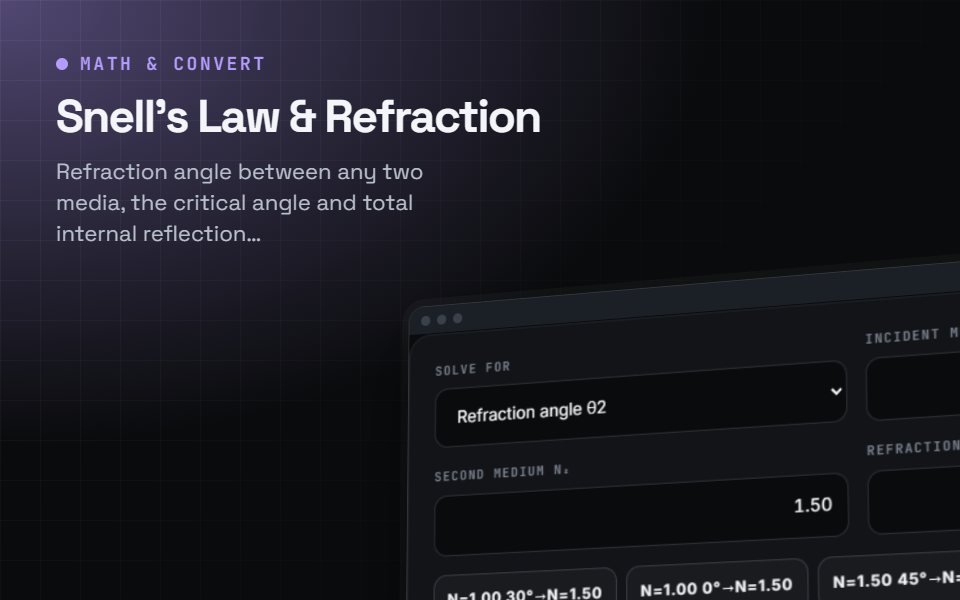
Refraction angle between any two media, the critical angle and total internal reflection condition computed and reported, plus unpolarised Fresnel reflectance and transmittance from the mean of s and p.